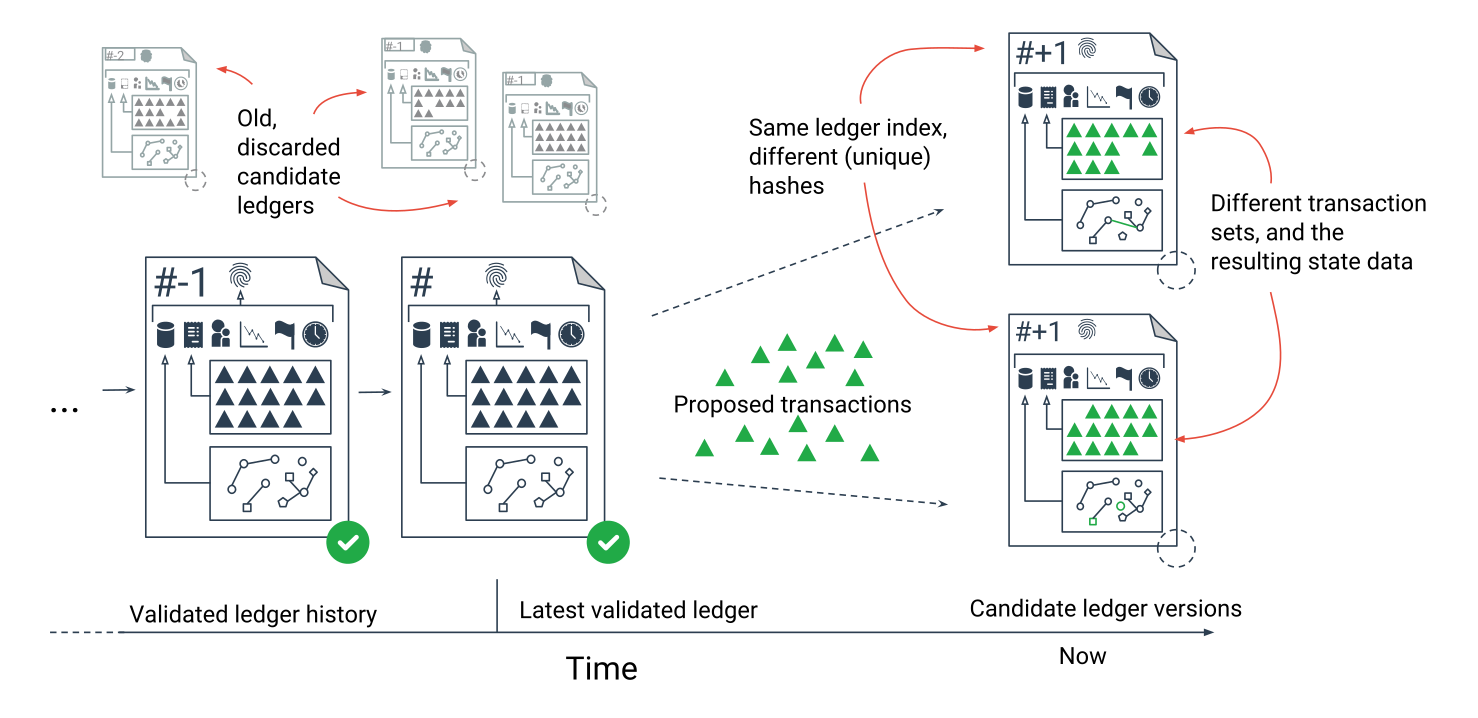
A ledger is a shared record of who owns what. The XRP Ledger (XRPL) keeps that record on many servers at once, and no single copy outranks the others. The ledger is the system, and XRP is one asset recorded in it. Most of the confusion around the name comes from mixing the two up.
How a transaction gets recorded
Picture a chain of pages. Each page points back at the one before it with a hash. A group of trusted validator servers checks that new data is valid and reaches consensus on it. When 80% of them agree on a set of transactions, the next page is added to the end of the chain and the cycle starts again. Nobody has to trust one operator, because no central authority exists and every copy of the ledger is equally valid.
How long does a round take? About three to six seconds.
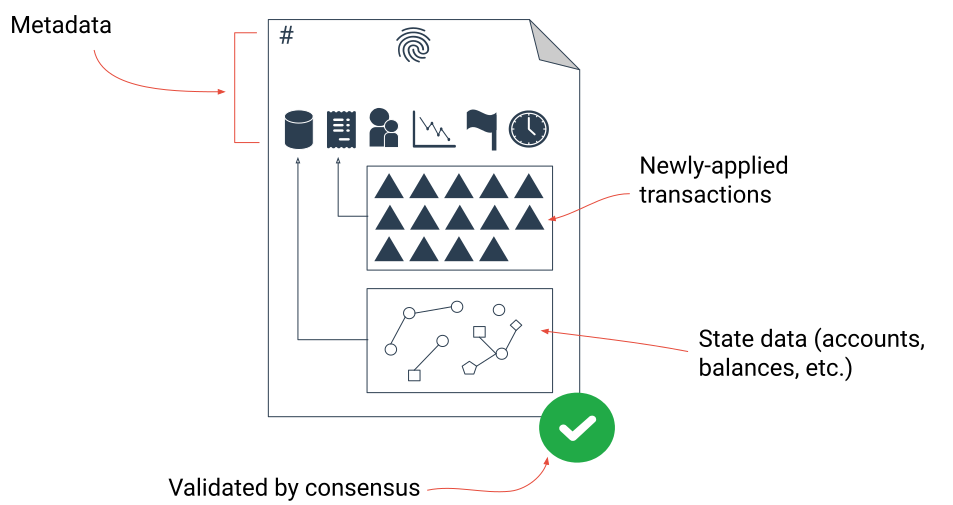
Recorded data stays recorded. It cannot be altered retroactively unless a majority of validators agree to the change, and in practice nobody can roll back a completed transaction. The consensus algorithm in the rippled repository is Byzantine Fault Tolerant, which is how the network settles transactions without a central operator.
No mining, just voting
The XRP Ledger has no mining, and its energy use is negligible. Validators vote on transactions instead of racing to solve puzzles. That vote runs among trusted validators; the consensus protocol guide shows how each server picks its Unique Node List (UNL) and how a round converges.
Anyone can run a validator, and over 120 are active, run by universities, exchanges, businesses and individuals. Of the 35+ on the Unique Node List, Ripple runs 1. The server software itself, called rippled, comes from the XRP Ledger Foundation.
XRP is not the ledger
The XRP Ledger is the system, and XRP is the digital asset it supports. The ledger holds balances, rules and history. XRP is one asset among the things recorded there.
XRP is native to the ledger and was designed as a gas token for network services and as a bridge between currencies. A fixed 100 billion XRP were created when the ledger began, and no more will ever be created. The available supply shrinks slowly as small amounts are destroyed to pay transaction fees.
The names do the rest of the damage. The ledger was originally called “Ripple”, after payments rippling through several hops and currencies. To stop the technology, the company and the asset blurring together, “XRP” came to mean the asset in every context. In May 2018 the community picked a new “X” symbol for XRP, to set it apart from the triskelion logo once used for both the company and the asset. Ripple, the company, contributes to the network, but its rights are the same as any other contributor’s.
What people use it for
The ledger was built for payments and financial applications. The protocol includes an exchange and an accounting system for tracking obligations in any denomination users choose. Escrow, Checks and Payment Channels sit on top for more specialized jobs. Builders point to tokenization of assets, online gaming, asset custody, NFTs and DeFi, and the network overview is explicit that the ledger is public and decentralized, not a private chain.
You will rarely touch the protocol directly. Custodial exchanges, token issuers, marketplaces, interfaces to the decentralized exchange and wallets provide the screens for buying, selling and trading. If you are about to open a wallet, go to the accounts section. If tokens are what you are after, start with trust lines and the built-in exchange.
Who runs the network
A peer-to-peer network of core servers relays and processes transactions around the clock. Every server keeps a complete copy of the latest state data for the whole ledger, plus recent transactions. Most servers monitor or propose transactions, and an important subset run as validators.
| Component | Role | Votes in consensus |
|---|---|---|
| Core server (rippled) | Peer-to-peer node that relays and processes transactions | Only if it runs as a validator |
| Validator | Core server that votes on which transactions are valid | Yes |
| Clio server | Serves HTTP and WebSocket APIs without joining the peer-to-peer network | No |
| Client library | Builds and signs transactions locally for an app | No |
Client libraries sign transactions locally, so a private key never has to cross a network. The wallets guide picks that thread up.
Mainnet, Testnet and Devnet
The live network is usually called Mainnet. Two developer environments, Testnet and Devnet, sit beside it, and you can create an account funded with 1,000 fake XRP on either one to try the ledger. Anyone can also set up their own server instance and connect. That openness is why developers can test ideas before touching real value, and why the validator set is not tied to one company.
What it costs to use
Two small costs: a fee per transaction and a reserve per account. Both were checked on 2026-10-21, and amendments can change them. The minimum cost of a standard transaction is 10 drops, and that XRP is destroyed rather than paid to anyone. An account must also keep a base reserve of 1 XRP plus an owner reserve of 0.2 XRP for each item it owns (Mainnet amounts). Reserved XRP cannot be sent to others. The account reserve guide and the transaction cost guide take each in turn.
Where it came from
Development began in 2011 with engineers David Schwartz, Jed McCaleb and Arthur Britto. The documentation dates the build to 2011 through early 2012, and the README records the ledger as created in 2012 with a finite supply of 100 billion XRP.
In September 2012, McCaleb and Britto, together with Chris Larsen, formed the company now called Ripple, then named OpenCoin Inc. They gifted it 80 billion XRP in exchange for its work developing on the ledger. In 2017 the company placed 55 billion XRP in escrow so the amount entering general supply would grow predictably.
Consensus, amendments and the line between XRP and the ledger each get a page in Basics.
Questions people ask
Are XRP and XRP Ledger the same?
No. The XRP Ledger is the blockchain, and XRP is the cryptocurrency it supports. XRP is native to the ledger and works as a gas token for network services and as a bridge between currencies. Ripple, the company, is a separate contributor.
What is XRP Ledger used for?
The ledger supports payments, a built-in exchange, escrow, checks and payment channels. Builders use it for tokenization of assets, online gaming, asset custody, NFTs and DeFi. Wallets, exchanges and token issuers build their products on top of it.
Sources
- What is the XRP Ledger? · xrpl.org · checked October 21, 2026
- XRPL Overview (About) · xrpl.org · checked October 21, 2026
- What is XRP? · xrpl.org · checked October 21, 2026
- Software Ecosystem · xrpl.org · checked October 21, 2026
- XRPLF/rippled README · XRP Ledger Foundation (GitHub) · github.com · checked October 21, 2026
- Transaction Cost · xrpl.org · checked October 21, 2026
- Consensus Principles and Rules · xrpl.org · checked October 21, 2026
- Reserves · xrpl.org · checked October 21, 2026
Image credits
- Validated ledgers form a chain. The next page exists in several candidate versions until the validators settle on one. — XRP Ledger Foundation and contributors (xrpl.org), MIT License, via source
- One ledger page: metadata, the transactions applied this round, and the state data they changed. — XRP Ledger Foundation and contributors (xrpl.org), MIT License, via source


Limits and defaults can change with node releases: each source shows the day it was checked. How we check facts · Report an error.